
Practical use and limits
Use it for: Use this as a review checklist when evaluating a ZDR API workflow: map content, tools, logs, keys, retention, and abuse escalation before procurement or launch.
Limits: Private Safety Processing was announced as a preview. Availability, configuration, legal exceptions, and technical details can change; this article is not a compliance certification or legal advice.
The announcement in plain English
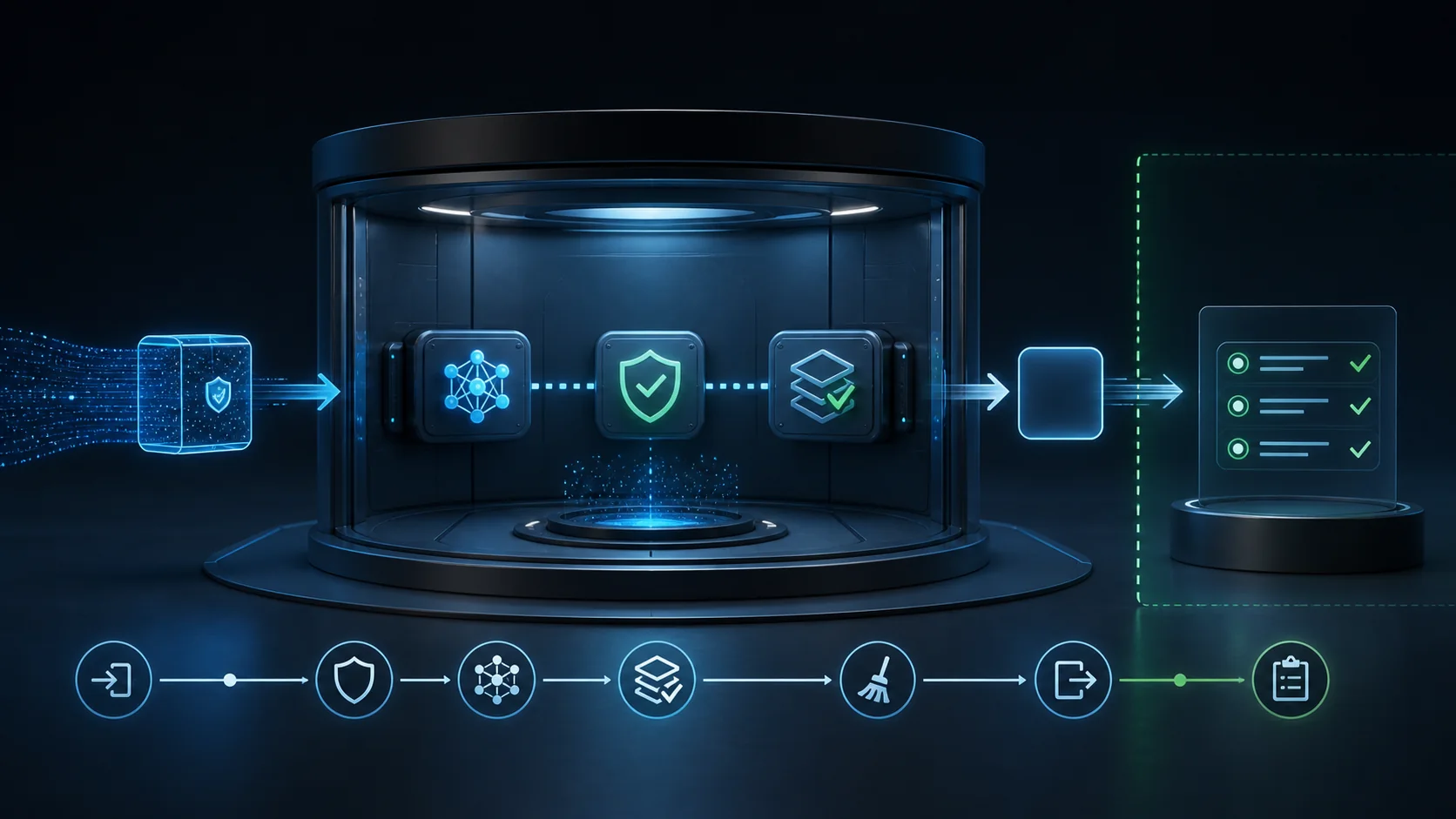
On August 19, 2026, OpenAI announced a preview of Private Safety Processing for eligible Zero Data Retention deployments. OpenAI describes Zero Data Retention, or ZDR, as a setup in which prompts and responses are not retained after processing and customer content is not available to OpenAI personnel for review. The new layer is intended to inspect patterns across related interactions without exposing the underlying content to OpenAI staff. That is a meaningful design goal, but it is still a preview and the announcement is not a contract for every API configuration.
Why per-request checks are not enough
A single API request can look harmless while a sequence reveals abuse, credential probing, or an agent that has continued acting outside its authority. OpenAI says existing ZDR-compatible safeguards evaluate interactions individually, while Private Safety Processing is designed to identify patterns across related interactions. The practical trade-off is familiar to security engineers: more context can improve detection, but collecting more context can increase privacy exposure. The proposed architecture tries to keep the signal while limiting access to the content.
What OpenAI says remains under customer control
For ZDR deployments, OpenAI says customer content remains on infrastructure controlled by the customer. It is also developing an option in which content is stored on OpenAI infrastructure but encrypted with keys controlled by the customer. In both cases, the company says automated systems can return a narrowly defined safety signal without sending the underlying prompts or responses to OpenAI personnel. The important word is says: implementation details, eligibility, configuration, and independent verification still matter.
The exception teams should not miss
The announcement includes a legal exception for images flagged as potential child sexual abuse material: those images may continue to be retained for manual review and reporting. This is not a reason to dismiss ZDR, but it is a reminder that privacy promises have scope and exceptions. A production data-flow document should name the content types, retention paths, abuse escalation paths, regions, subprocessors, and logs rather than reduce the whole arrangement to a marketing label.
A sensible implementation checklist
Before enabling a privacy-sensitive workflow, ask for the exact ZDR eligibility and endpoint configuration; map prompts, tool outputs, files, traces, and application logs; decide who controls encryption keys; test deletion and incident-response procedures; and document what your own team retains. For agents, also record the authorization boundary and stop conditions. A provider can reduce its access to content, but it cannot make an application’s own verbose logs, browser history, or copied transcripts disappear.
The useful conclusion
Private Safety Processing points toward a better enterprise pattern: safety systems should be able to reason over risk signals without turning customer content into a permanent provider-side archive. The announcement does not prove that every ZDR deployment now meets a particular regulatory standard, and it does not remove the need for threat modeling or vendor review. Treat it as a promising architectural direction to test against your data-flow and compliance requirements once the planned technical paper and rollout details arrive.
Frequently asked questions
Does Zero Data Retention mean OpenAI can never retain anything?
No. ZDR is a scoped deployment commitment, and OpenAI’s announcement describes an exception for images flagged as potential child sexual abuse material. Review the current service terms, endpoint eligibility, and abuse-handling policy for your configuration.
Is Private Safety Processing generally available?
Not according to the August 19 announcement. OpenAI described it as being tested with early customers and said it planned to share a technical white paper in September 2026.