


Practical use and limits
Use it for: Use this article as a launch-day evaluation checklist: freeze representative coding, document, tool-use, and long-context tasks, then compare correctness, latency, tokens, failures, licensing, and data handling with the model you already operate.
Limits: Hy4 preview specifications, access, pricing, and documentation can change. Tencent's blind test is an internal evaluation, not an independent universal benchmark; this article is not a model recommendation or a performance guarantee.
The short version: a large release with a practical target
Tencent released Hy4 preview on August 28, 2026, positioning it as an open-source frontier model built for productivity. The headline specifications are large: 770 billion total parameters, 49 billion active parameters per token, and a context window exceeding one million tokens. Those numbers make the release notable, but they do not by themselves tell a developer whether Hy4 is the right model. The more useful question is whether its long-context and agent behavior remain reliable when a task includes a repository, several documents, tool calls, and a real delivery constraint. This article separates the release facts from the tests that still need to be run.
What the architecture numbers mean—and what they do not
Hy4 uses a mixture-of-experts design: the model has a large total parameter pool, while only a subset is activated for each token. Tencent reports 770B total parameters and 49B active parameters. Active parameters can help control inference cost relative to a dense 770B model, but they do not make the model lightweight. Memory for weights, runtime overhead, communication between experts, quantization, batching, and the serving stack still determine whether a team can run it. A one-million-token context is similarly a capacity claim, not a guarantee that every detail will be retrieved accurately or that a long prompt will be economical.
The evidence Tencent has shared is promising but bounded
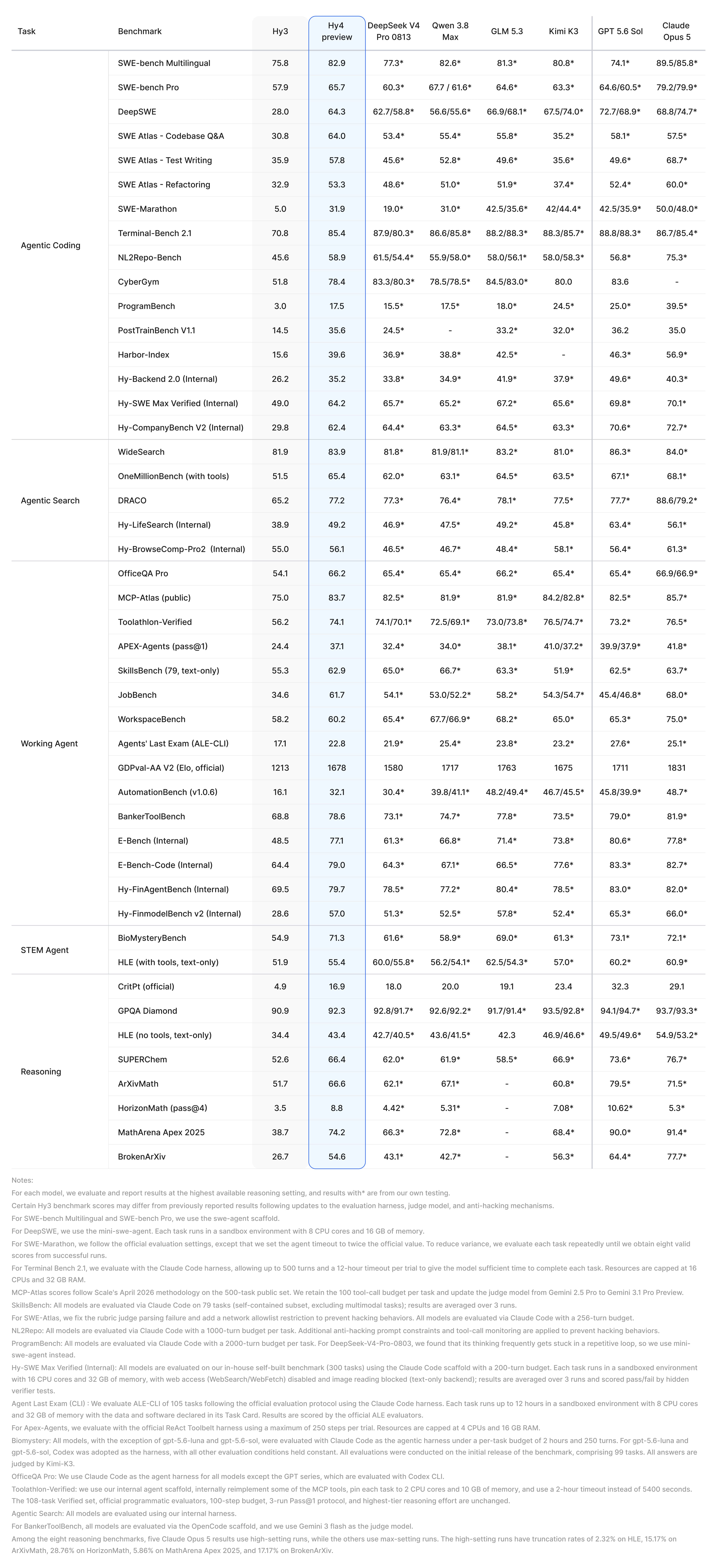
Tencent says it ran a blind side-by-side evaluation with 163 internal experts across 203 engineering tasks. Hy4 preview received an average score of 2.99 out of 4, compared with 2.92 for GLM-5.3 and 2.94 for Kimi K3. This is relevant evidence because the tasks are closer to real engineering work than a single public quiz. It is still an internal evaluation: the task set, sampling procedure, rater calibration, prompts, tool permissions, error handling, and statistical uncertainty are not enough to establish a general ranking. Treat the result as a reason to test Hy4, not as proof that it wins every coding or reasoning workload.
Where the model is designed to be useful
The release emphasizes four families of work. In software engineering, Tencent highlights long-horizon planning, debugging, verification, and front-end interaction quality. In office and analysis workflows, it points to cross-file understanding, financial analysis, and delivery into documents, spreadsheets, and presentations. In game development, the target is turning a natural-language requirement into a playable prototype and iterating with an engine. In science, Tencent describes improvements for difficult problems including AI research, molecular dynamics, condensed-matter physics, and foundational mathematics. These are product directions, not independent capability certificates; a serious evaluation should test representative tasks with a fixed rubric and record failures as carefully as successes.
Access, pricing, and the first operational questions
Tencent says Hy4 preview is available through WorkBuddy or CodeBuddy, Yuanbao, and ima, and that developers can access it through Tencent Cloud TokenHub and OpenRouter. The release pricing is reported as CNY 6 per million input tokens, CNY 18 per million output tokens, and CNY 0.3 per million cached tokens. Before moving a workload, confirm the exact model identifier, region, rate limits, billing unit, cache behavior, data retention, service-level expectations, and whether the API returns tool-call and reasoning fields in the format your application needs. A low token price can be outweighed by retries, long outputs, latency, or a higher rate of human review.
A sensible developer test plan
Start with a small, reversible benchmark built from your own work. Freeze ten to twenty tasks across coding, document extraction, spreadsheet reasoning, tool use, and long-context retrieval. Give each model the same files, instructions, time budget, and tool permissions. Score correctness, completeness, changes required by a human, latency, input and output tokens, failure recovery, and unsafe or overconfident behavior. For a repository task, require a patch, tests, and a short explanation; for a document task, require citations to the supplied files; for an agent task, log every tool call. Compare Hy4 preview with the model you already operate, and keep the rejected outputs. That record is more useful than repeating a vendor leaderboard.
The open-source label still needs a licensing and deployment check
‘Open source’ is valuable only when the published weights, code, license, model card, hardware requirements, and redistribution terms are clear enough for your use case. Check the exact repository and release artifact rather than assuming the same terms as an earlier Hy model. Then test the supported inference stacks, quantization quality, multi-GPU communication, cold-start time, and memory headroom. A model that is technically downloadable may still be impractical for a small team to serve, and an API deployment may carry different privacy and data-governance obligations from self-hosting.
Bottom line: test the workflow, not the headline
Hy4 preview is a meaningful release because it combines a very large MoE model, a one-million-token context target, open weights, and distribution through both Tencent products and external API channels. Its strongest early case is long-running, tool-assisted productivity work. The evidence is not yet a universal performance verdict, and the preview label matters: behavior, price, availability, and documentation may change quickly. Developers should run a task-level comparison, verify licensing and data handling, and set a fallback before putting production work behind it. This is an independent explanation of a new release, not a recommendation to adopt the model or a guarantee of performance.
Frequently asked questions
Is Hy4 preview already a finished production model?
No. It is a preview release. The published specifications and access paths are useful starting points, but availability, behavior, pricing, and documentation should be checked against the live official model page before deployment.
Does 770B mean Hy4 is automatically better than smaller models?
No. Total parameter count is an architecture scale, not a universal quality score. The active-parameter design and one-million-token context change the engineering trade-offs, while task accuracy, latency, cost, and reliability still need direct testing.
Can a small team run Hy4 locally?
Do not assume so from the release announcement. Verify the exact weights, quantization options, license, hardware requirements, inference framework, and memory usage. API access may be more practical, but it introduces separate cost and data-governance questions.